We’re Jamin’ We’re Jamin’ – Apple Jam

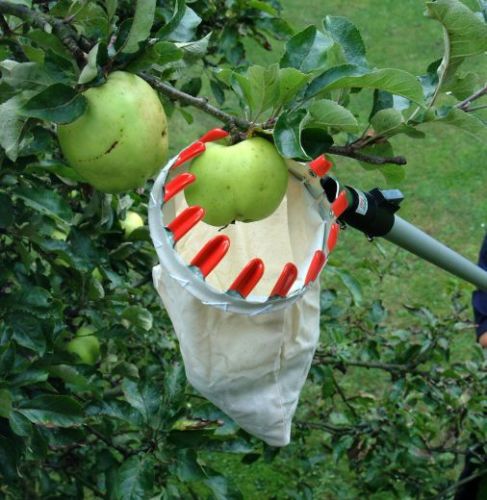
20151003_093545408_iOS Every year we always seemed to be unprepared for the apples falling  in our garden, for a long time we’ve been talking about trying to do something with them rather than just composting the fallen fruit. Last years crop was very poor but this year was looking a lot better. fruit picker

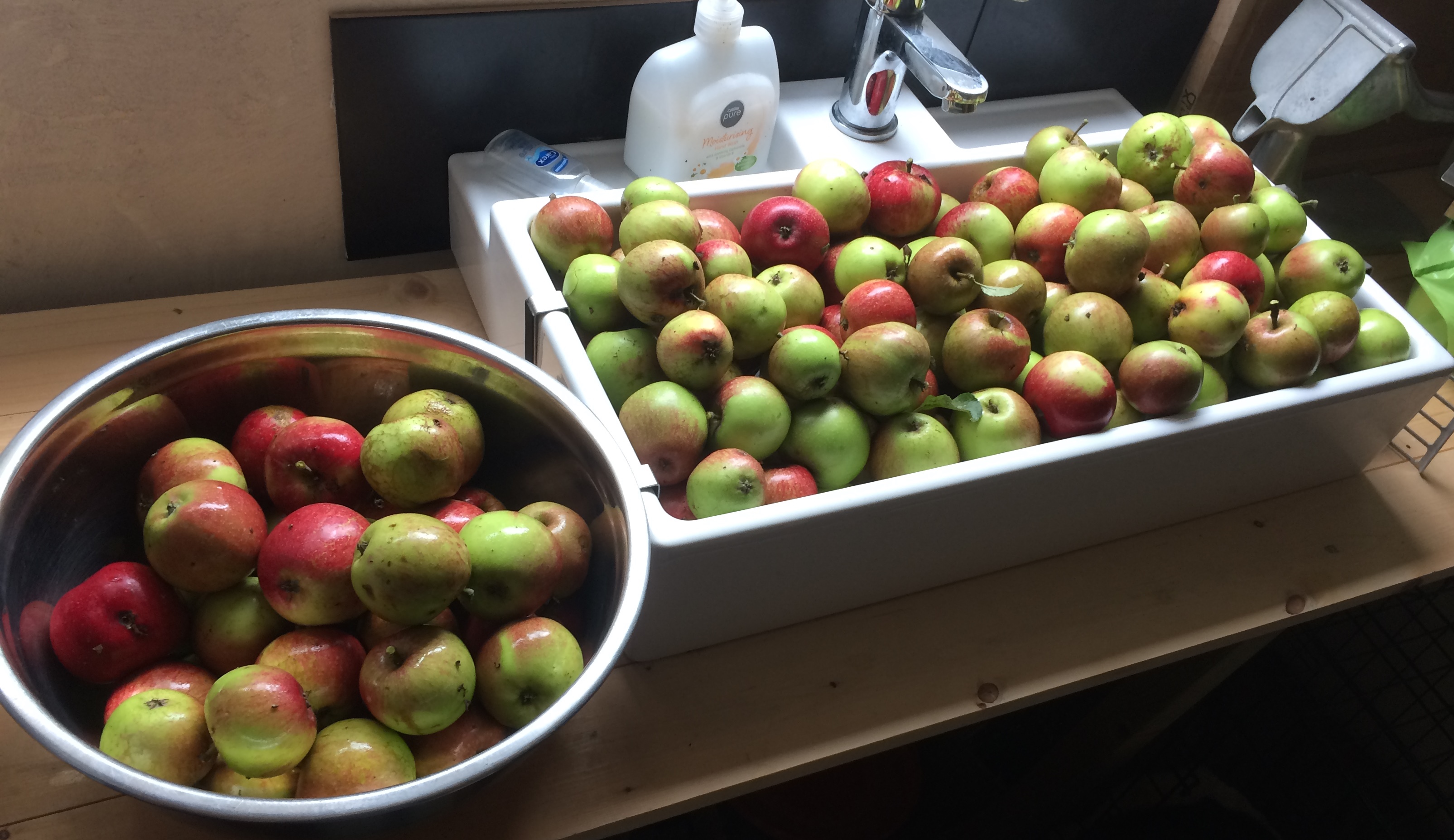
So armed with our fruit picker we collected as much as we could and looked at Jam recipes for a easy turnaround into something storable. The Autumn apple recipe we used was at www.allrecipes.co.uk.

Ingredients
Makes: 3 (340g) jars apple jam

  • 1.35kg cooking apples – peeled, cored and sliced
  • 600ml water
  • 3 large lemons, zested and juiced
  • 1 pinch ground cinnamon
  • 1 pinch ground nutmeg
  • 6 whole cloves
  • 1.10kg to 1.35kg granulated sugar

20151003_093637957_iOSPeeling and coring the fruit was a bit of an effort but we got through it.

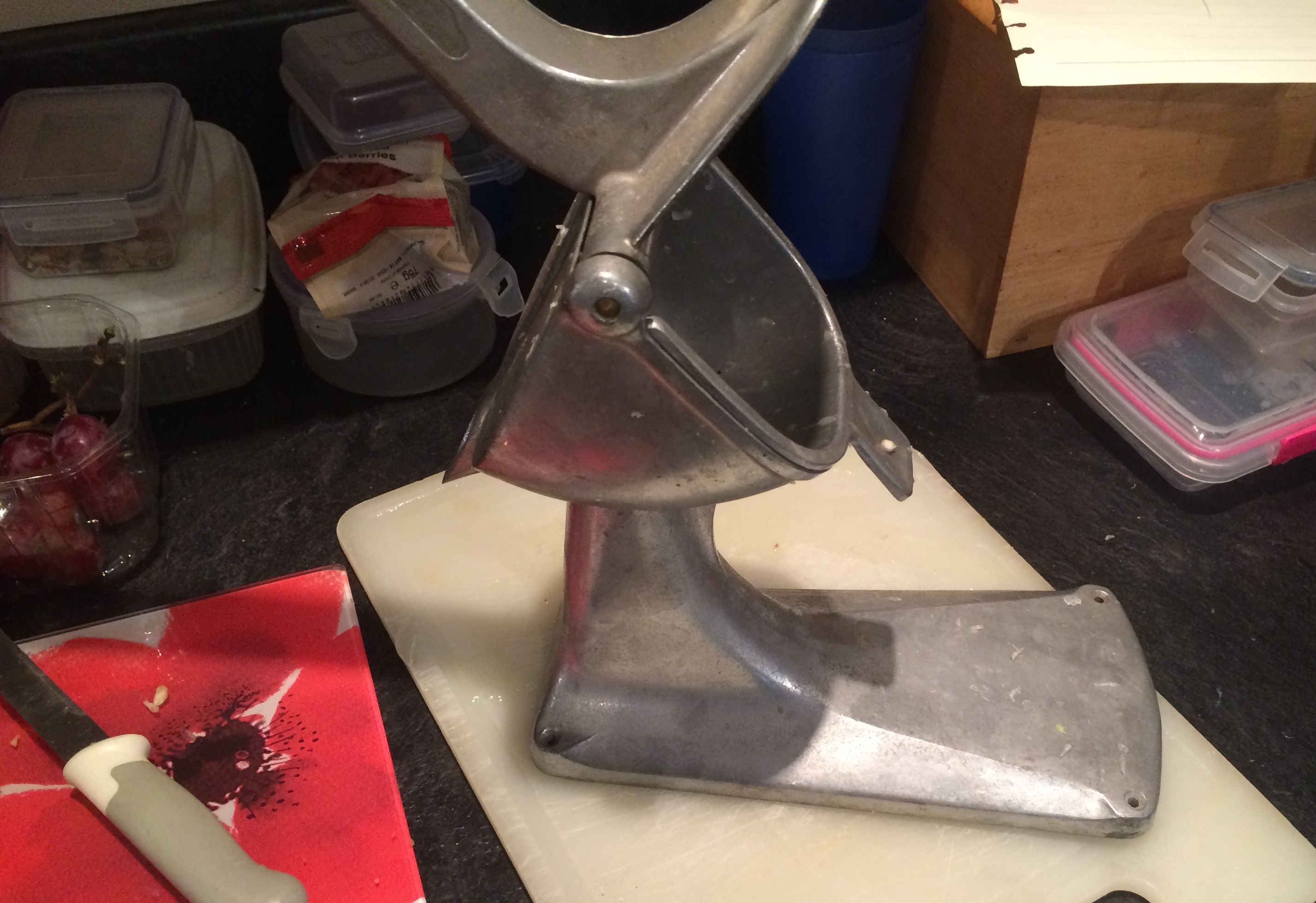
20151003_134544524_iOSI picked up on old fruit press recently at a barn shop for £8, I thought I’d give this a go for juicing the Lemons20151003_134443044_iOS

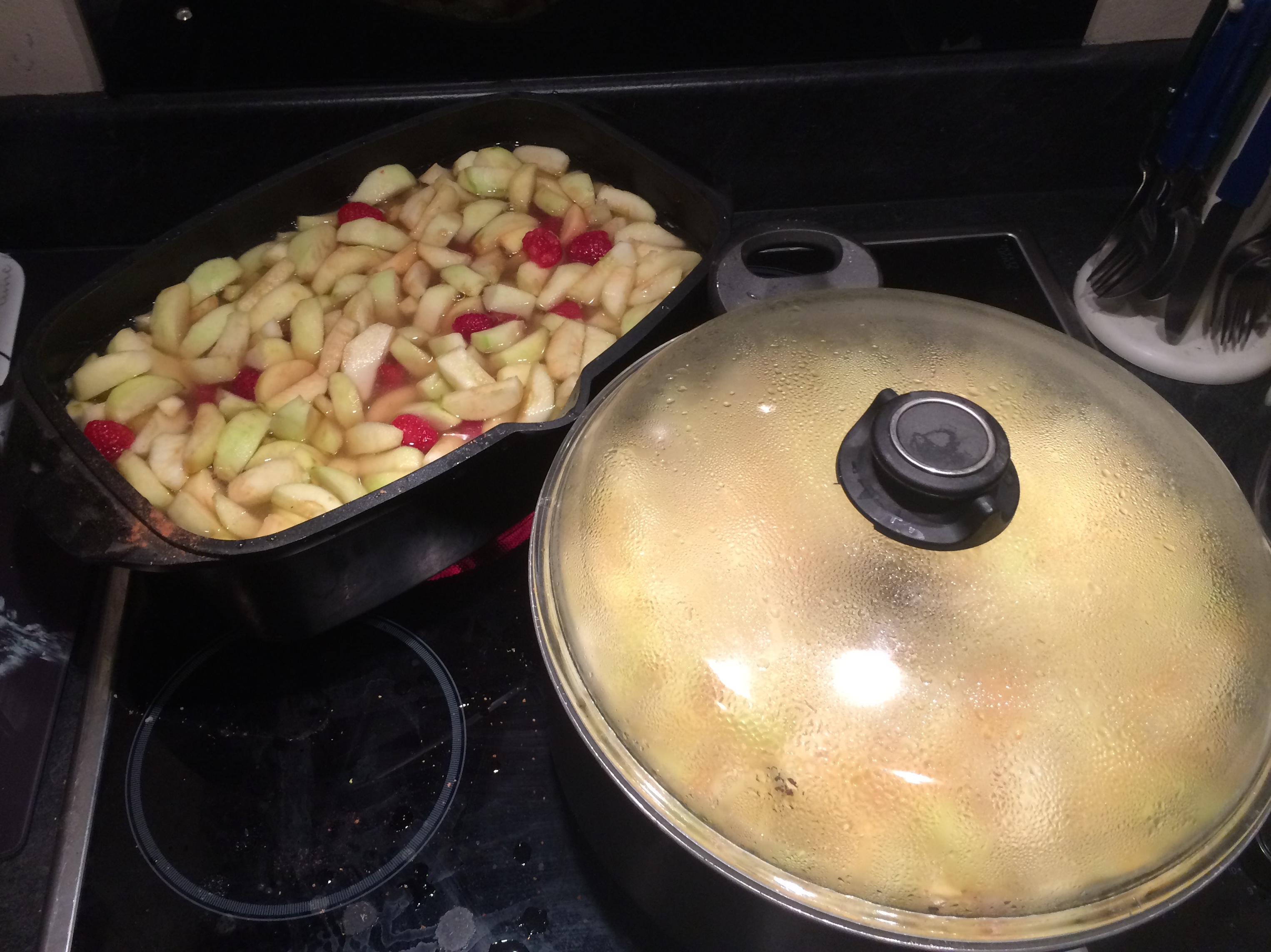
In a large preserving pan over a medium heat, combine the apples, water, lemon juice and zest and spices. Cook and stir for 90 minutes until the apples have reduced and are soft and mushy.

We modified the recipe for 1/2 of the batch and added raspberries.

20151003_143749179_iOSPass the apple mixture through a sieve into a clean saucepan and discard the whole cloves. Weigh the apple pulp and add 340g sugar for every pound of pulp.

Gently boil the jam until the setting point is reached. Check this by putting a drop of the jam onto a cold plate and pushing it with your finger; if it wrinkles it is ready.

Sterilising the jars and lids is important so look up how to do this, we used Jamie Oliver’s video on Youtube

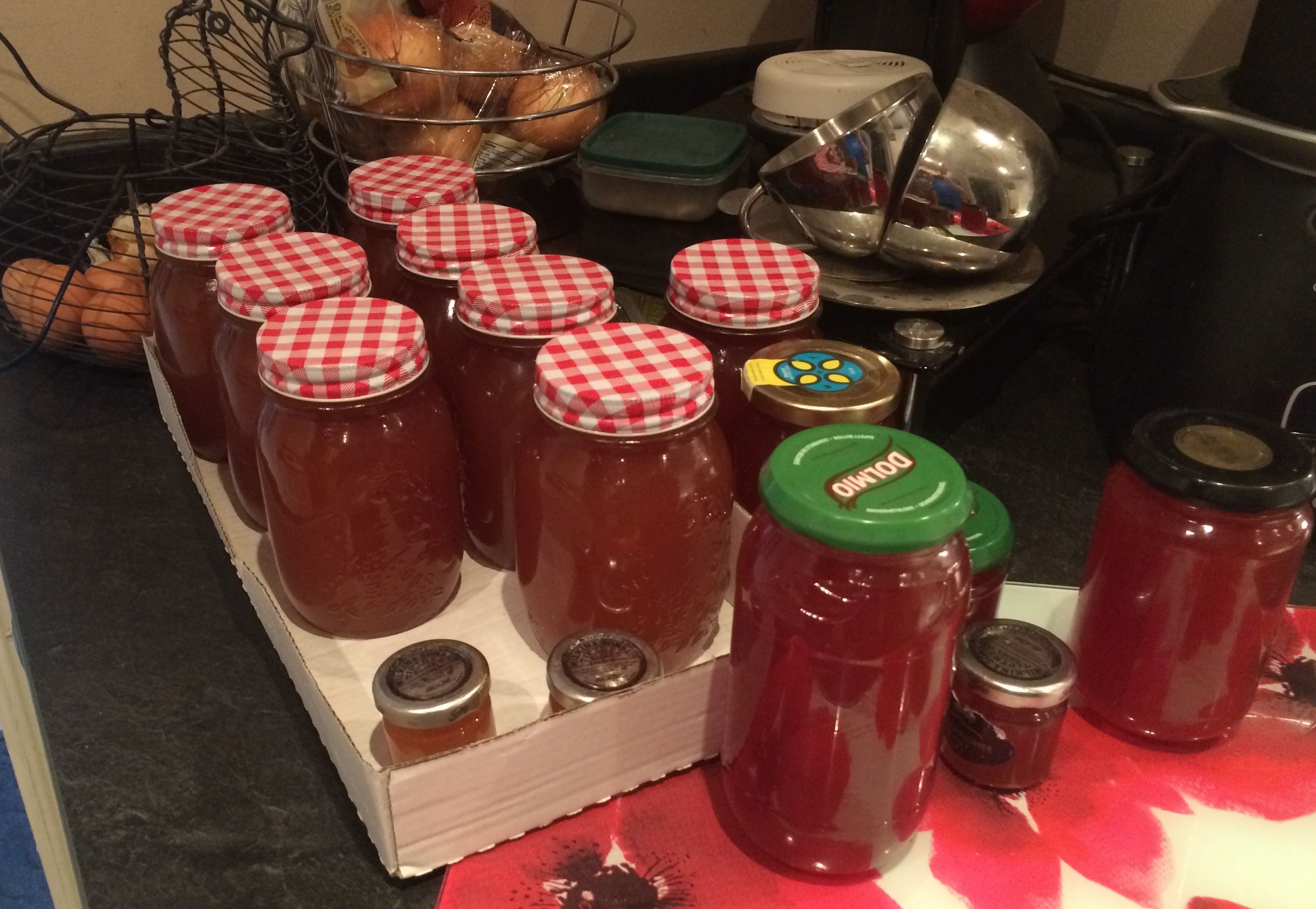
20151004_091006189_iOSTransfer the jam into sterilised jam jars and cover immediately. Leave undisturbed overnight in a cool place before serving.

20151004_090322034_iOSThis morning I sampled the Jam this morning on some toast and it was pretty good!

Posted in Food | Tagged | 1 Comment

The Bee Diaries – Part 10 – Smell that Nectar!

bee dairies logoI know I only posted a few days ago and was hive4talking about working towards wintering the bees, but the sun is shinning, its been a warm 16 to 18 degrees centigrade, spending a few hours or so working around the hive the smell coming from the hive is really strong, I think the smell is nice it reminds me of summer and smells like combination of nectar, honey and wax.

Looking through a few references on the internet I found a good explanation on www.honeybeesuite.com, the smell is typical for Autumn, the source of the smell is nectar, most probably from plants in the aster-flower-beesaster family, including goldenrod and small daisy-like flowers that grow in clusters.

When the bees start to dry this nectar into honey the smell can be very strong. The aster honey produced using these flowers isn’t always to everyone’s liking, however the honey tastes nothing like the odour they give off. Nevertheless, many beekeepers prefer to let the bees keep the aster honey for themselves.

Anyway winter is inevitable and I will need to get hive set up ready so next time I will go through what I will have done to prepare for this and some of things to do over the winter period and preparation for next year.

Posted in Bee Keeping | Tagged , , | 2 Comments

The Bee Diaries – Part 9 – Tick Tock, Tick Tock!

bee dairies logoWow where has the time gone? firstly, sorry for those following this blog, I should have posted before now but, man, its been a busy year.

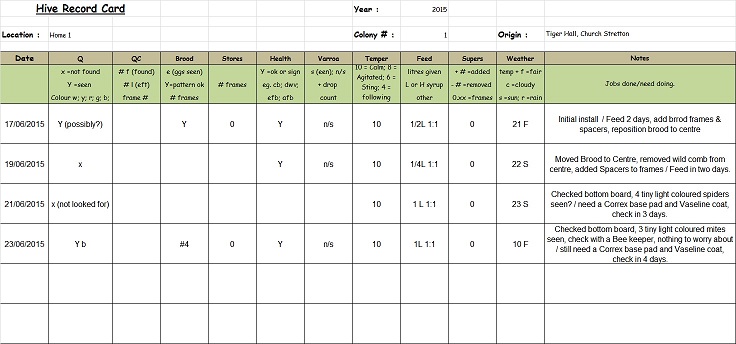
The bees are all doing well, I’ve carried out regular inspections and detailed these onto my hive record card and I have to say so far I haven’t been stung! no doubt that will change now I’ve mentioned it.

The bees have been very calm during inspections, the record card asks for a Temper judgement of 1 to 10 with a guide of 10 = Calm; 8 = Agitated; 6 = Sting & 4 = following. In all but one occasion I put down a 10, and on the last two inspections I used little to no smoke.

In my last post I was feeding the bees a 1:1 sugar / water syrup and I stopped feeding in late August and removed the rapid feeder.

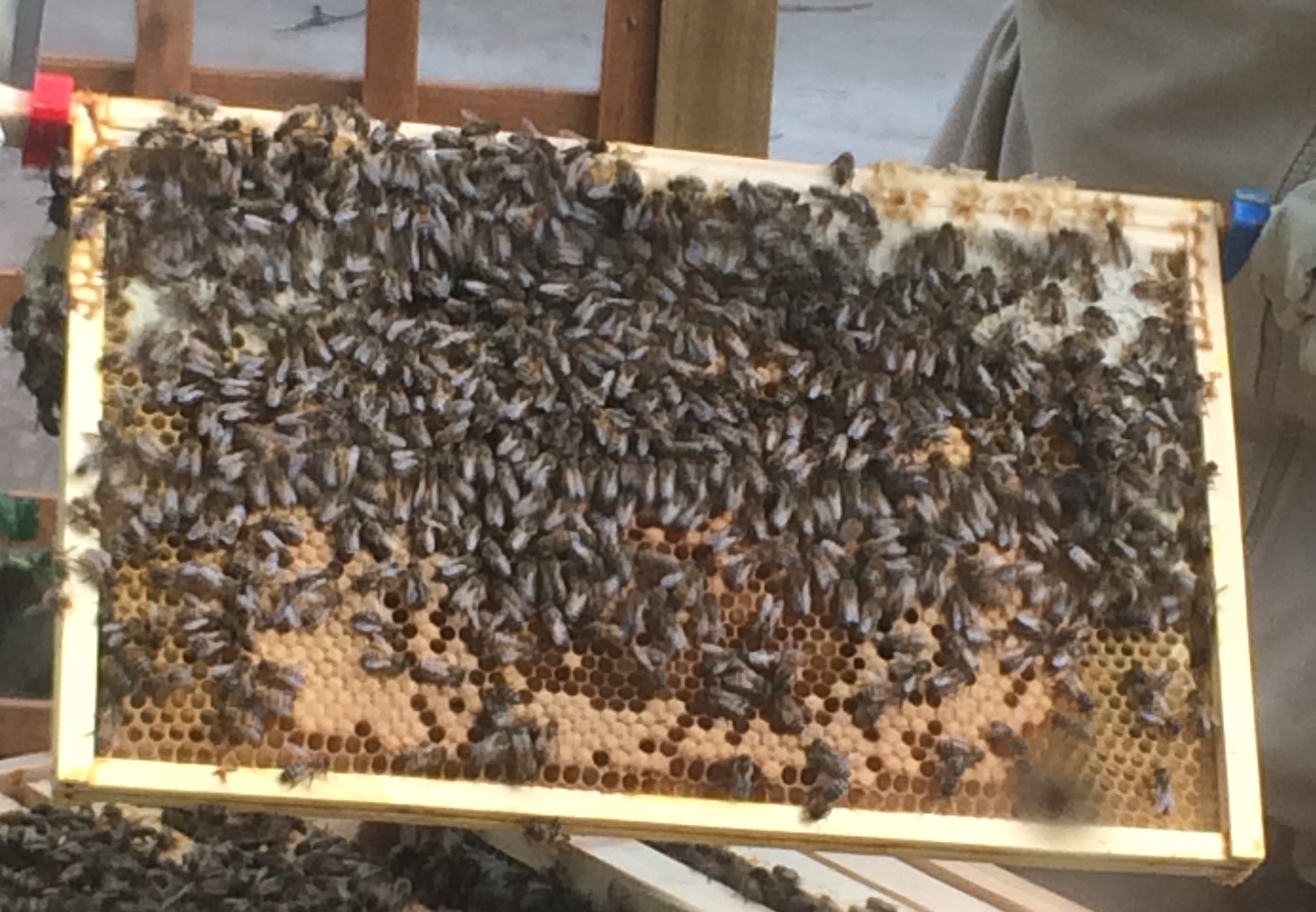
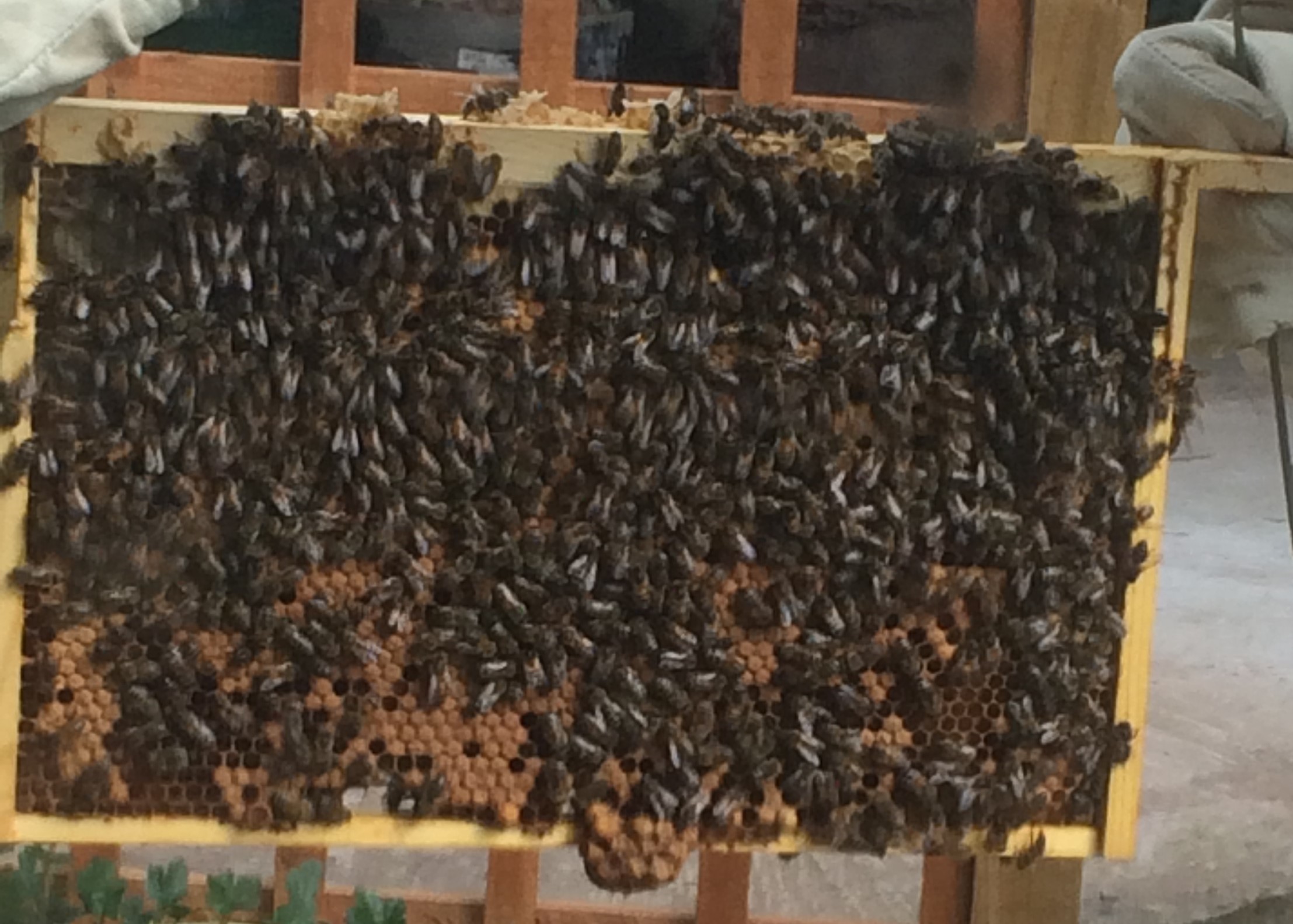
IMG_1385 (2)At this time I also had to to a detailed inspection as I hadn’t spotted the queen for a few weeks and was starting to panic a little, this is quite common, certainly for the new IMG_1388 (2)bee keeper (not finding the queen i mean, not the panicking!), this was a good opportunity to get some images of the Brood frames as shown.IMG_1390 (2)

The  Queen was eventually found alive and well.

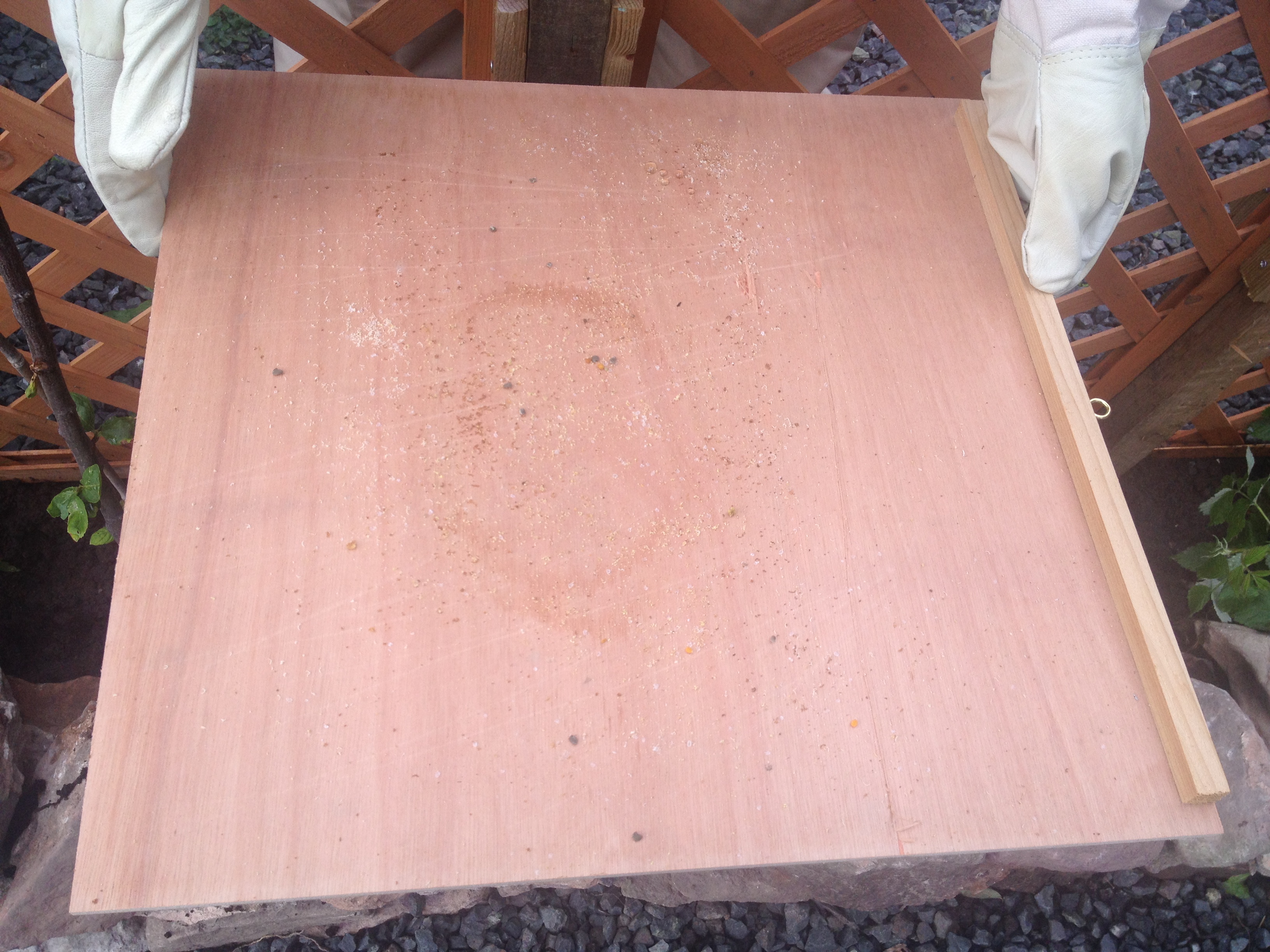
One of the things that I had failed to do was to use a piece of plastic Correx on the base board to stop the board from looking like the one in the image shown. IMG_1405This is basically all of the hive waste, pollen, moisture, mites, insects, etc. that drop though the mesh floor. By studying this board gives you a reasonable idea of the hive condition at a glance. I clean this board off at each inspection and have now put a section of blue plastic Correx in there.

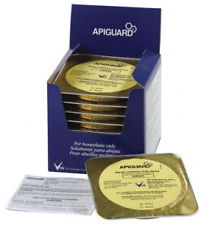
Up until last week I had seen no Varroa mites, whether it is because of the coloured base board that I can now see them clearer I’m not sure, however now like most hives I need to treat for Varroa.apiguard

Its usual to remove the crops of honey during August, however I only had 4 frames in the super so chose to leave these for the bees to build on ready for winter. Typically after removal of the crop in August you would then treat for Varroa by using Varroacides and restrict the entrance to prevent other bees or wasps from robbing your hives. September would be the time to start feeding for the winter period, obviously supplementing the honey that you’ve stolen! Remove any Varroa treatment at end of treatment period. I am currently carrying out an emergency treatment for Varroa using Apiguard.

IMG_2221I have also fitted a mouse guard to restrict the entrance, this should also make it easier for the guard bees to do their job easier on inspection for intruders.

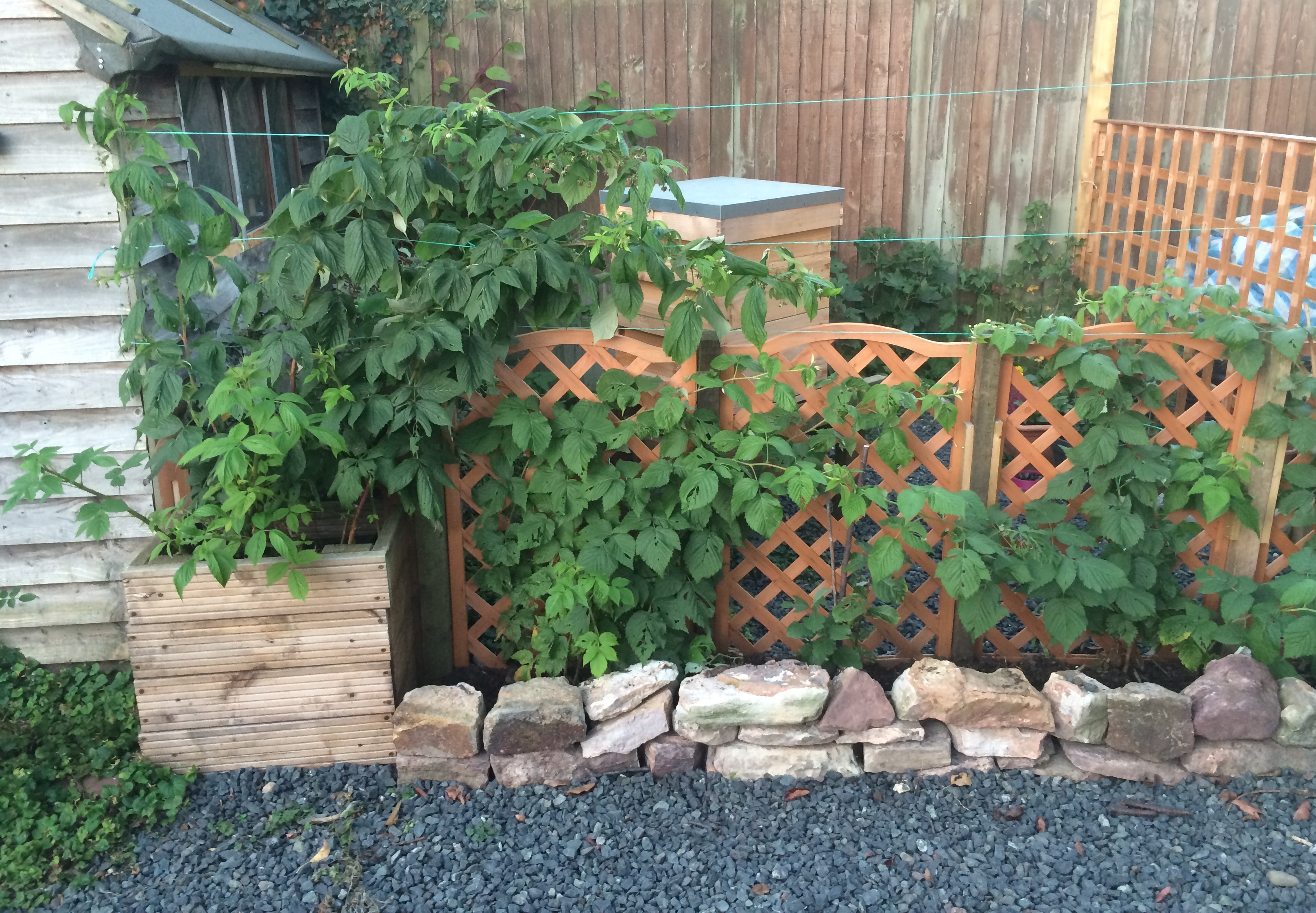
IMG_2218Earlier in the year I placed some trellis fencing around the apiary and planted some Plum and Raspberry, and inside some forage in the form of gooseberry, lavender, blackberry, these have all come on well and should provide them and us with some plentiful forage for the next year, as well as some protection against the elements once full established.

I will try to report on my winter set up once I get some guidance from my local club….

Posted in Bee Keeping | Tagged , , , , , | 3 Comments

Prostate Cancer

As I am approaching 50 very quickly this is a survival topic worth considering, this post is a simple link http://www.thesurvivaldoctor.com/2015/09/16/prostate-cancer-early-detection/

Simple, interesting read.

best of health…….

Posted in Health & Fitness | Tagged | 3 Comments

Anti-Prepping – Refusal to prepare

Human-Jerky-Sticks-600I have shamelessly used an article from the Internet which is quite outrageous and politically incorrect satire; please take it as it is meant.
Why shouldn’t anti-preppers have lists, too? After all, they are going to need to learn a vast array of dangerous and totally gross new skills to survive, such as standing in food lines, looting retail stores and giving BJs in barter for medicine.
Frankly, I think all of us in the prepper community have been a bit discriminatory in not providing “unpreparedness lists” for all those who plan to be unprepared. After all, their necessary skills are much more difficult to master than ours! It’s way more difficult, for example, to learn how to give BJs for food than it is to just store some extra food in the first place, so the anti-preppers really have their work cut out for them. They need to start training now!
It might also be useful for them to engage in “anti-prepper foreign exchange programs” where clueless city-dwelling liberal Americans who think socialism is awesome are flown to Venezuela for a few months, where they get to witness a collapsing socialist utopia in its full glory (while learning unpreparedness skills they can use back home in the coming collapse).
In the hope of helping anti-preppers acquire the skills they need to be fully unprepared, I’ve assembled this list of extremely useful unpreparedness skills they can start learning and practising right now.

Skill #1) Standing in line for 12 hours at a time

  • As Venezuelan citizens have rudely discovered, your No. 1 activity in a collapse will be standing in line. Not just one line, mind you, but lots of different lines.
  • First, there’s the FEMA line where they don’t give you food.
  • Then there’s another line for medication at the hospital where they don’t give you medication.

You’ll also need to find a line for government-issued water (sanitized with chlorine, of course), government-issued toilet paper and government-issued newspapers that keep you informed of what an amazing job the government is doing of keeping you standing in lines.
Fortunately for you, the government is already preparing a nationwide network of comfortable camps for anti-preppers, where you can concentrate your work efforts to help the government in exchange for food and protection. These are sort of like summer camps, but they will operate year-round. These resort-like “vacation camps” are run by FEMA, which upholds essentially the same comfort standards as the Hyatt Regency.

Skill #2) Looting retail establishments for desperate supplies

After you’re done standing in line, you’ll discover that the government isn’t really prepared to help you. Then, you’ll resort to looting retail establishments, joining with all the other looters who have arrived at the same conclusion.
Unfortunately for you, only the very first looters get the loot, and the first looters are going to be the more street-wise people (gangs, hoodlums, etc.) who are technically far more informed about how quickly society can collapse.
TIP: How to tell the difference between looting geniuses and looting morons: The geniuses are the ones taking the medical supplies. The morons are the ones stealing big screen TVs.
Unless you start looting immediately, you will be too late to loot anything of much value. While everyone else will have looted items of real barter value — tampons, coffee, bottled water and ammo — you’ll be stuck with a store full of holiday gift cards, portable MP3 players and useless iPhones.
Hence, the need to brush up on your looting skills ahead of time. How do you accomplish that? Buy a hoodie and move to Ferguson, Missouri, then wait for another riot to begin. Once the looting begins, dash for the nearest pharmacy and steal some stuff! (Be sure to set fire to it on your way out, because burning up local businesses is just another way to demonstrate how much you’re totally committed to social justice.)

Skill #3) Unintentional fasting (also known as starvation)

If you’re not used to going without food — and you refuse to store any — you may want to practice fasting.
Just to be clear on the definitions:

“Fasting” is the term used to describe intentional starvation.
“Starvation” is the term used to describe unintentional fasting.

Anti-preppers need to become familiar with starvation ahead of time so that it’s not such a shock to their system when the starvation begins.
An easy way to practice this is to just stop eating for a few days at a time and see what happens. (Drink water, obviously, or you’ll die and be turned into human jerky, see below.)
If you find that you don’t like starvation and don’t wish to participate in practicing it, then you may wish to store some damn food so that you don’t have to starve when things go wrong in society.

Skill #4) Making human jerky with a solar food dehydrator

Heck, who needs emergency food storage when there’s already so much food walking around at the office?
Yep, cannibalism is the last-ditch food storage strategy for the chronically unprepared.
Unfortunately for vegans and clean food enthusiasts, human meat is heavily contaminated with mercury, lead, cadmium and toxic chemicals — mostly due to all the vaccines, toxic personal care products and contaminated food that people eat. I’m not even sure that human jerky would pass USDA inspection standards for beef… and those inspection standards aren’t very stringent to begin with.
But human meat is “free range” and “fair trade,” so it’s probably worthy of eating anyway. (It’s definitely not Non-GMO Project Verified, unfortunately, as most buffet-munching obese Americans have essentially been raised on the same GM corn grain used to fatten cows.)
Nevertheless, if you’re an anti-prepper, you may want to acquire an Excalibur food dehydrator now — a device you’ll need to make human jerky sticks that you can barter for other necessities. If the grid is down, you’ll need a solar-powered food dehydrator, so you might want to start building that now. BONUS: If you use solar power to make human jerky, it’s eco-friendly human jerky!
Once all this is in place, all you need is human flesh. Fortunately, thanks to Planned Parenthood, you no longer have to think of this as actual “human flesh.” Instead, you can tell yourself you’re only dealing with “tissue samples” that seemingly have nothing to do with living, breathing human beings. And because most anti-preppers are also strong advocates of mass abortions, they already have the psychological skills to lie to themselves about what’s living vs. dead in the first place!

Skill #5) Playing the victim and blaming someone else for your stupidity

When things go wrong and you find yourself totally unprepared, it’s crucial to blame somebody else.
This is a skill set already possessed by Obama supporters, leftists and other ideological “victimology” experts who think nothing is ever their fault. (…essentially, every professor at a liberal arts university.)
When the stuff hits the fan and you have no food, no water, no internet, no silver coins, no cash, no medicine and no idea what just happened, the obvious answer is to blame the Tea Party.
If you can’t blame the Tea Party, find some white people to blame somewhere, preferably heterosexual macho males who own guns. It’s GOTTA be their fault, right? They own GUNS, for cryin’ out loud! And they act like MEN! (That’s just gotta be wrong at some level, doesn’t it?)

Full credit to the originator of this – whoever they are………
Posted in Preparedness | Tagged , , | 2 Comments

Make A Bee Waterer And Help Hydrate Our Pollinators

wemustknow.koen's avatarwe must know

A single bee tends to at least 2,000 flowers daily, with their tiny wings beating 10,000 times per minute, carrying pollen, and dramatically assisting our food supply. All that work makes the bees thirsty, especially on a hot day.

View original post 175 more words

Posted in Bee Keeping | Leave a comment

The Bee Diaries – Part 8 – Two Weeks in

bee dairies logoSince the first inspection 10 days ago Britain has had some of the hottest weather for this time of year, recorded temperatures highs of  36.7C (98F).

I have been observing the bees daily and there seems to be a good procession of traffic in and out of the hive. On average I have been topping up the feed with a 1:1 1kg to water about every 3 to 4 days and this appears to be the general requirement, I will probably continue this until that have filled their brood frames.

4622404431_1035d4bca6Bee Bearding

One observation on one of the hottest evenings, was a mass of bees outside of the hive around the door, it appeared out of the ordinary so I checked and its called Bee Bearding (image shown is not my hive). This clustering on the front of the hive almost all of the time this is totally normal, and even a good sign. This can be seen in strong colonies as the population is at its height and as the bees are storing and ripening honey at a blinding pace. To keep the honey at correct temperature and allow for airflow in the hive, a small to large number of adult bees will hang out in the front, helping the internal temperature to stay cool. You might even see some fanning of their wings, pushing air into the hive on the hottest days.

Bearding is often a totally healthy sign of a colony working at its peak. It can be a sign of a strong colony with a large population, all in service to their single purpose: overwintering successfully with enough honey stores to survive.

My concern was that this occurred on one of the hottest days so I was considering ventilation, I knew that they still had enough space to keep building but this should be a consideration. Another aspect to consider regarding space swarming, if they are out of room this could be a possibility.

feederMy solution was to slide out the hive floor, on my hive this slides easily so no need to get all dressed up into the protective gear, the mesh floor provides protection from intruders and far better ventilation.

Today during the second inspection I left off the lid of the feeder tray, the reason is because I can’t see anyway that the hive is been ventilated through the top vents in the roof with the lid of the feeder in place? Whereas the dome in the centre has vent holes so hopefully the hive will get better ventilation – I will continue to monitor and report back at a later date.

Robbing

I was showing a my family the hive from a safe distance (1m from the hive rear), I spotted a bee that looked larger than my average size bee, I thought it odd and jokingly commented that it didn’t look like one of my bees! A few seconds later a guard bee had dragged it to the ground and a fight ensued, the raiding bee was left on the ground. I assume that the bee was attempting to rob from the hive, but I cannot be sure.

BBKA

I have looked at joining the British Bee Keepers Association, its actually better to join a of the local affiliated group, mine is Shropshire Beekeepers’ Association, the full membership benefits are listed as:

  • Membership of the British Beekeepers Association
  • A monthly BBKA Newsletter
  • Insurance cover up to £5 million for
    (a) Public Liability for harm caused by your bees
    (b) Public liability for claims arising out of swarm collection
    (b) Product Liability (including sales through Farmers’ Markets)
  • Bee Diseases Insurance to help cover the loss of equipment following a compulsory destruction order
  • Reduced subscriptions to the journals BeeCraft (monthly) and the Beekeepers Quarterly (optional)
  • Help with acquiring bees through the collection of swarms or the purchase of colonies
  • Access to SBKA equipment such as an extractor, microscope etc.
  • Support to help with your practical beekeeping problems
  • etc……………

Not bad for £28 per annum!

Still to come – I need to get the monthly tasks planned out

Posted in Bee Keeping | Tagged , , , , , , , , , , , , , | 3 Comments

Making the dash count

I do love this phrase, it pretty much defines my aim in life.

demo_tombstoneCertain times in your life opens your eyes to how important life actually is and how easily it can be taken away,

“Making the dash count”

One day your time will come to shuffle off this mortal coil, and however you chose to be remembered, somewhere there will be your name, a short message and two dates, your birth and your death. between these is a simple ‘-‘ dash. This small symbol represents your life.

People often say to me “you’re always doing something!”, well you know what, I’m just trying to make the dash count!

Posted in Health & Fitness | Tagged | Leave a comment

The Bee Diaries – First inspection

bee dairies logoPreviously we installed Bees into their new hive.

Having checked the feed of the bees roughly every 2 to 3 days, I have ensured that they have enough of the syrup and have added approximately 1kg diluted into 1lt of water each visit.

So far they bees have been very calm; I too have been pretty relaxed and careful when carrying out any activities around the hive, this is something that was advised by professional, easy in theory!

Play Flight

One of the general observations made during a reasonably warm day was what seemed to be ‘more than normal’ activity and loud buzzing at the door of the hive, Bees seemed to be just flying about ½ metre from the entrance but remaining facing the hive, some would then spiral upwards and away. I checked on this activity and it’s referred to as ‘play flight’.

This is when after the 4th or 5th day after emergence the adult work bee, they tend to do it all at the same time on a warm day with little wind, once airborne they fly backwards, facing the hive then circling away until finally the turn their line of flight and circle around the hive, gradually spirally outwards. During this time they are learning the area and the surroundings just as scoping the area and storing it like Goggle earth so they can find their way back.

Record Keeping

hive recordKeeping a good record of the inspection serves as a reminder of the status and allows you to plot progress and keep tabs on expansion of the hive, swarm potential, pests and general condition of the bees. I have put together a simple record card in spreadsheet format modified from one of the many on line sources.


The Inspection

IMG_0384The base board or hive floor, on my hive is a simple drawer that can be easily pulled out to reveal the dropping, pollen, foreign matter, mites or lice that have dropped from the brood chamber and through the mess floor. On both occasions that I have checked this I have found what looked like 3 to 4 tiny spiders or mites. I videoed these and took some close up pictures, having these checked I’m told they are not bee pests, so all is good.mite lice

One tip that I learnt at the taster course was to use Vaseline on the base board to catch any of the mites and to stop them from going back into the hive, this can be applied to a Correx sheet for ease of cleaning and replacement.

I inspected the brood frames one by one and saw a small amount of activity on the new frames that I inserted; also it was good to finally see the queen who has a blue marking identifying that she is a 2015

Queen Marking

queen marking 2Queen bees can survive a number of years and the system of Queen marking colours has been devised which, if followed, give an indication of the age of the Queen. The Queen is marked with a spot of paint on her thorax (between the head and abdomen) with the colour scheme shown.

queen marking 1There is a simple mnemonic that I saw on the Cheshire BKA, so each year ending in a 0 or 5 is blue, then white, yellow, red and green.

Next Time…. we’ll look at planning out the year and getting registered with the BBKA

Posted in Bee Keeping | Tagged , , , , , , , , , , , , | 2 Comments

The Bee Diaries – Arrival of the Bees – Suplemental

bee dairies logoFollowing the last publication two days ago of the ‘Arrival of the Bees‘ posting, I asked Charles Millar (Whom I acquired the Bees from) of Bee-keeping at Tiger Hall, to give my video and comments the once over just in case I had missed anything.

Charles Wrote:

“If you haven’t already done so, I suggest moving your frames right next to the ones from the nuc straight away.  If you don’t, the bees may start to build wild comb in the gap.
Your frames are DN1 – i.e. they are not self spacing like the ones in the nuc.  It is essential therefore that you use the correct spacers on the ends of your frames. If you don’t you will have serious problems.  You should be able to fit 11 frames plus a dummy board into the brood box (or, at a pinch, 12 frames.)  (I would recommend that you buy DN4 – I.e. Hoffman – frames in future.)
If you haven’t got spacers, in the mean time you will have to position your frames ‘by eye’. You are aiming for the same spacing as provided by the frames in the nuc, which is about 35mm from centre to centre.
You should move the 5 frames from the nuc into the middle of your brood box so the bees can expand in both directions.
A little nerdy info – the main reason smoke works is that it masks the transmission of pheromones within the colony, in particular alarm pheromone. The ‘filling up with honey’ effect is also true but it is slower, and needs more smoke, which is more disruptive to the colony.  You will probably need only a little smoke at the start of your inspection and then just the odd puff to move the bees away from the frame ends.
Anyway, well done, and good luck!”

Today’s urgent task was to heed the warnings above and move the original frames to the centre of the hive, apply spacers to the frames and fill up any gaps with more frames.

Upon inspection of the hive the first thing I noted was that the feed was almost out, therefore they are consuming about a 1 cup of sugar / 1 cup of water per day. so I topped up with a further days mix and will look to top it up tomorrow and then again about every 3 days until I can gauge their consumption.

wild combRemoval of the crown board revealed a 80mm wild comb attached to the crown board as predicted by Charles, this was subsequently removed, its amazing how quickly and perfectly this was formed, I feel slightly guilt now given the effort that went into making it!

I applied the spacers to the frames as detailed in a previous post

A big thank you for Charles for looking in on the posts, that wild comb would have been a mess if left any longer.

Next Time…. I will still be reporting on my first inspection, and detailing what tasks I need to be doing this month with the apiary.

Posted in Bee Keeping | Tagged , , , , , , , , , , | 2 Comments